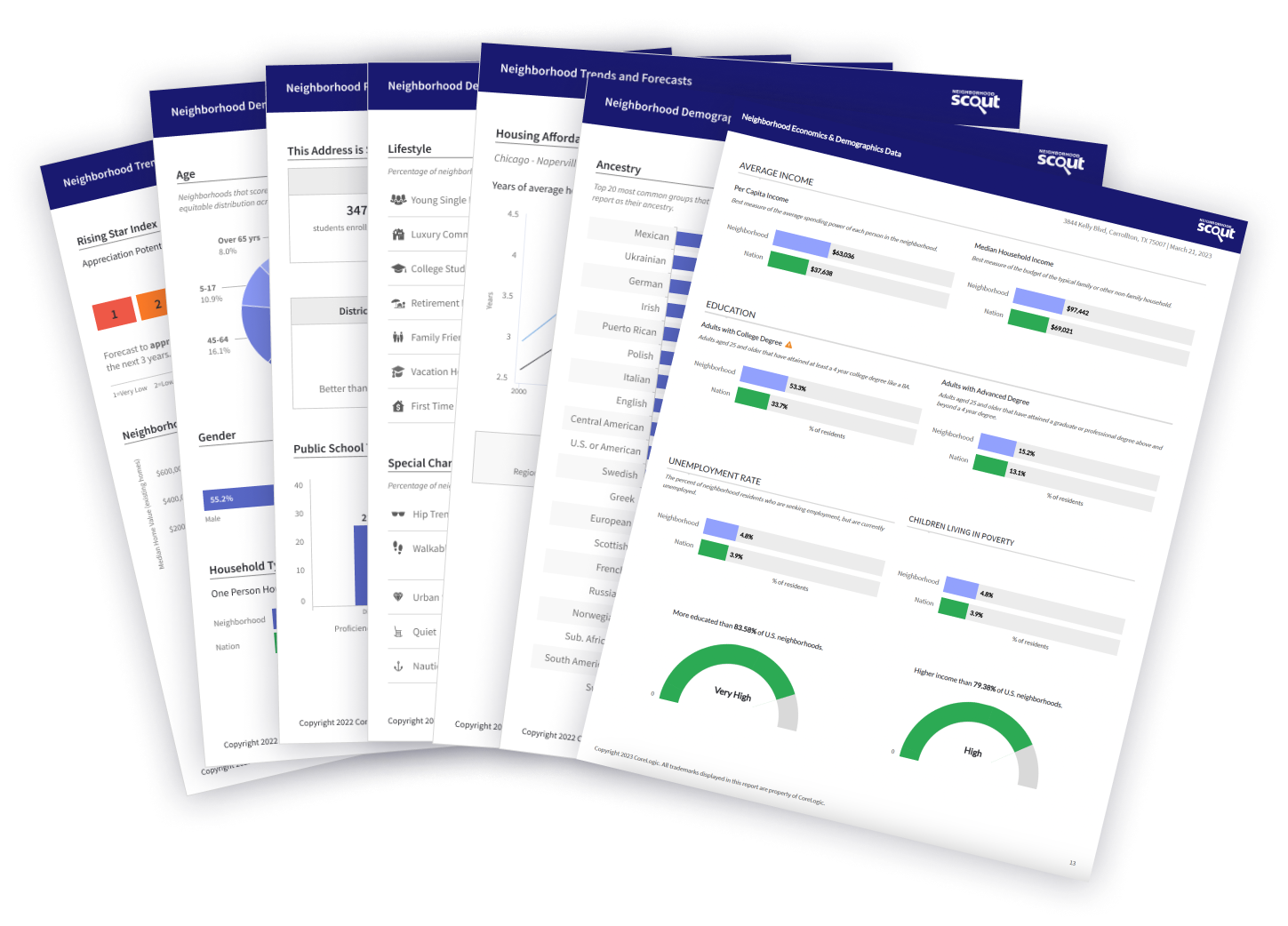
What do we mean by a neighborhood?
NeighborhoodScout® uses the official government designation for neighborhoods - the census tract.
Census tracts are small, relatively permanent subdivisions of a county that are defined by the U.S. Census Bureau in conjunction with local authorities all across the country to define real neighborhoods that are bounded to contain areas with homogeneous population characteristics (including economic status, lifestyle, and living conditions). Census tracts usually have 4,000 persons, but can range between 1,500 and 8,000 persons. This is the most fine-grained area for which detailed information is made available from the government, to protect the individual privacy of each of us. Because census tracts are based on population, they vary in size depending on the density of settlement. In urban areas, they are small, and in rural areas they can cover an entire small town or even a few small towns in very rural areas.
Since census tracts are subdivisions of a county, we did a spatial overlay of the census tracts onto city and town boundaries using a geographic information system to properly assign each census tract to its appropriate city or town. Then we named each census tract to the local colloquially recognized neighborhood name for that spot (e.g., Boston, MA (Dorchester). If there was not a name available, we named the census tract by the largest street intersection in the census tract (e.g., Worcester, MA (Lincoln St/Plantation St)
Why we don't use Zip Codes as neighborhoods
Zip codes were developed by the Postal Service for the purpose of delivering mail, but were never intended to define coherent neighborhoods. In addition, Zip Codes can have as many as 10 distinctly different census tracts contained within them. When distinct census tracts are blended together in a single Zip Code, the data reflects their average conditions and often gives a false sense of the area. The result is that potentially great matching neighborhoods can be missed, and erroneous matches can also be produced and delivered to you.
Using census tracts makes great matches possible, and helps people find the areas that are best for them and their families. Because we are committed to providing the highest possible quality and finding the neighborhoods that best meet your criteria, we use census tracts. And, as always, we show you the actual street map of the neighborhood so you know exactly where your best matching neighborhood is located.
What is a Condition Alert?
A condition alert is a condition in the neighborhood that triggers an alert. NeighborhoodScout contains condition alerts to highlight conditions that are extreme, whether good or bad. This helps answer crucial questions about the state of the neighborhood being evaluated, such as:
What are the risks of violent crime here?
Is the risk of home break-ins or other property crimes increasing?
Does real estate here hold its value?
Are the trends in local vacancies or unemployment concerning?
...and dozens more.
Information at a glance that you need to know to invest, appraise or finance a property.
Prospect Lefferts Gardens Northwest median real estate price is $2,541,479, which is more expensive than 96.3% of the neighborhoods in New York and 99.0% of the neighborhoods in the U.S.
The average rental price in Prospect Lefferts Gardens Northwest is currently $3,111, based on NeighborhoodScout's exclusive analysis. Rents here are currently lower in price than 49.7% of New York neighborhoods.
Prospect Lefferts Gardens Northwest is a densely urban neighborhood (based on population density) located in Brooklyn, New York.
Prospect Lefferts Gardens Northwest real estate is primarily made up of small (studio to two bedroom) to medium sized (three or four bedroom) apartment complexes/high-rise apartments and townhomes. Most of the residential real estate is renter occupied. Many of the residences in the Prospect Lefferts Gardens Northwest neighborhood are relatively historic, built no later than 1939, and in some cases, quite a bit earlier. A number of residences were also built between 1940 and 1969.
Home and apartment vacancy rates are 7.1% in Prospect Lefferts Gardens Northwest. NeighborhoodScout analysis shows that this rate is lower than 52.0% of the neighborhoods in the nation, approximately near the middle range for vacancies.
Notable & Unique Neighborhood Characteristics
The way a neighborhood looks and feels when you walk or drive around it, from its setting, its buildings, and its flavor, can make all the difference. This neighborhood has some really cool things about the way it looks and feels as revealed by NeighborhoodScout's exclusive research. This might include anything from the housing stock to the types of households living here to how people get around.
Modes of Transportation
If you like to ride the train to work, this neighborhood may be for you. NeighborhoodScout's research revealed that 62.1% of the Prospect Lefferts Gardens Northwest neighborhood's commuters ride the train to and from work each day, which is more than we found in 99.9% of America's neighborhoods.
Real Estate
The Prospect Lefferts Gardens Northwest neighborhood is very densely populated compared to most U.S. neighborhoods. In fact, with 44,961 persons per square mile in the neighborhood, it is more packed with people than 98.2% of the nation's neighborhoods. Being a walkable neighborhood can help increase property values for the simple reason that people enjoy it and value it. To put it plainly, despite our love affair with the automobile, American's enjoy taking to the streets, sidewalks, paths, and courtyards of a place to get a coffee, relax, and take in the sights and sounds. And, according to NeighborhoodScout's exclusive and first quantitative walkable score index, the Prospect Lefferts Gardens Northwest neighborhood is one of the most walkable neighborhoods in America.
In addition, one of the really unique and interesting things about the look and setting of the Prospect Lefferts Gardens Northwest neighborhood is that it is almost entirely dominated by large apartment buildings, such as apartment complexes or high-rise apartments. 76.1% of the residential real estate here is classified as such. This puts this neighborhood on the map as having a higher proportion of large apartment buildings than 96.1% of all neighborhoods in America.
Furthermore, do you watch 'This Old House' on Public Television? Do you love the idea of fixing up a Colonial or Victorian era home, complete with the charm of yesteryear? Do you like to stroll or drive streets lined with gracious older residences? If you found yourself nodding yes to any of these questions, you are going to be interested in this unique neighborhood. The Prospect Lefferts Gardens Northwest neighborhood stands out on a national scale for the sheer concentration of historic residences it contains: 76.2% of the residential real estate here was built from 1939 or earlier, some much earlier. This is a greater concentration of historic homes than 99.4% of the neighborhoods in the United States.
Car Ownership
American households most often have a car, and regularly they have two or three. But households in the Prospect Lefferts Gardens Northwest neighborhood buck this trend. 59.6% of the households in this neighborhood don't own a car at all. This is more carless households than NeighborhoodScout found in 99.2% of U.S. neighborhoods.
Diversity
Did you know that the Prospect Lefferts Gardens Northwest neighborhood has more Haitian and Czechoslovakian ancestry people living in it than nearly any neighborhood in America? It's true! In fact, 9.0% of this neighborhood's residents have Haitian ancestry and 1.1% have Czechoslovakian ancestry.
Prospect Lefferts Gardens Northwest is also pretty special linguistically. Significantly, 13.7% of its residents five years old and above primarily speak French at home. While this may seem like a small percentage, it is higher than 99.5% of the neighborhoods in America.
The Neighbors
How wealthy a neighborhood is, from very wealthy, to middle income, to low income is very formative with regard to the personality and character of a neighborhood. Equally important is the rate of people, particularly children, who live below the federal poverty line. In some wealthy gated communities, the areas immediately surrounding can have high rates of childhood poverty, which indicates other social issues. NeighborhoodScout's analysis reveals both aspects of income and poverty for this neighborhood.
The neighbors in the Prospect Lefferts Gardens Northwest neighborhood in Brooklyn are middle-income, making it a moderate income neighborhood. NeighborhoodScout's exclusive analysis reveals that this neighborhood has a higher income than 45.9% of the neighborhoods in America. With 10.3% of the children here below the federal poverty line, this neighborhood has a higher rate of childhood poverty than 50.7% of U.S. neighborhoods.
What we choose to do for a living reflects who we are. Each neighborhood has a different mix of occupations represented, and together these tell you about the neighborhood and help you understand if this neighborhood may fit your lifestyle.
In the Prospect Lefferts Gardens Northwest neighborhood, 55.9% of the working population is employed in executive, management, and professional occupations. The second most important occupational group in this neighborhood is manufacturing and laborer occupations, with 21.6% of the residents employed. Other residents here are employed in sales and service jobs, from major sales accounts, to working in fast food restaurants (13.5%), and 9.1% in clerical, assistant, and tech support occupations.
Languages
The languages spoken by people in this neighborhood are diverse. These are tabulated as the languages people preferentially speak when they are at home with their families. The most common language spoken in the Prospect Lefferts Gardens Northwest neighborhood is English, spoken by 70.7% of households. Other important languages spoken here include French and Spanish.
Ethnicity / Ancestry
Culture is the shared learned behavior of peoples. Undeniably, different ethnicities and ancestries have different cultural traditions, and as a result, neighborhoods with concentrations of residents of one or another ethnicities or ancestries will express those cultures. It is what makes the North End in Boston so fun to visit for the Italian restaurants, bakeries, culture, and charm, and similarly, why people enjoy visiting Chinatown in San Francisco.
In the Prospect Lefferts Gardens Northwest neighborhood in Brooklyn, NY, residents most commonly identify their ethnicity or ancestry as Sub-Saharan African (11.9%). There are also a number of people of Haitian ancestry (9.0%), and residents who report African roots (8.7%), and some of the residents are also of Jamaican ancestry (5.9%), along with some South American ancestry residents (4.6%), among others. In addition, 35.2% of the residents of this neighborhood were born in another country.
Getting to Work
How you get to work – car, bus, train or other means – and how much of your day it takes to do so is a large quality of life and financial issue. Especially with gasoline prices rising and expected to continue doing so, the length and means of one's commute can be a financial burden. Some neighborhoods are physically located so that many residents have to drive in their own car, others are set up so many walk to work, or can take a train, bus, or bike. The greatest number of commuters in Prospect Lefferts Gardens Northwest neighborhood spend between 45 minutes and one hour commuting one-way to work (36.9% of working residents), longer and tougher than most commutes in America.
Here most residents (62.1%) take the train to get to work. In addition, quite a number also drive alone in a private automobile to get to work (12.6%) . This neighborhood is distinguished by the high number of residents who take the train to work each day, which can be a very good way to get to work at a lower cost and with less pollution.
SCOUT’s patented match algorithm identifies the most similar neighborhoods to a subject location, and quantifies the similarity to the subject location. This allows analysts to identify the most similar neighborhoods in a local market area for appraisals, investments, and research.
The algorithm uses 273 neighborhood conditions, identifies the dominant dimensions underlying the conditions and calculates the similarity. This captures the true culture and character of locations, economic conditions, and trends.
The closer to 100% means the locations are nearly identical. 80% is a very good, but not excellent match, and so forth.